
To Win The Hollywood Rat Race, You Must Enjoy The Process
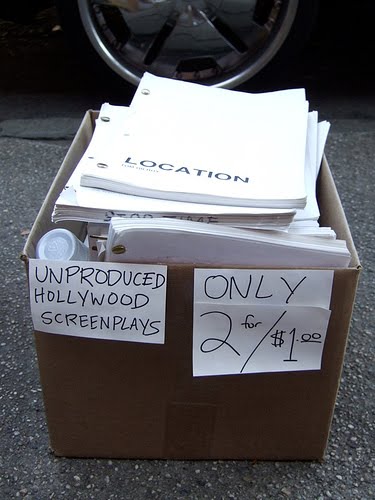
I came across this picture on the internet the other day and it reminded me of a Los Angeles billboard ad campaign a few years ago for a nationwide bank that was just making its presence known in the City of Angels. I can’t quite remember which bank it was. I could research it, but the specific name doesn’t really matter. What matters is the slogan on one of their ads overlooking the infamous Hollywood & Vine intersection:
“More ATMs in LA than Unproduced Screenplays!”
I might be paraphrasing here, but the point is clear: Hollywood is so notorious for its plethora of screenplays that it’s being used as a marketing gimmick. But this isn’t just some unfair stereotype, this is true. Hollywood is home to an insane number of screenplays flailing about without purpose or support. There are a whole lot of people who decided to write a screenplay.
I don’t want to make it seem like screenplays are the only dime-a-dozen entity in Hollywood. There are plenty of under-prepared actors roaming the town as well. You can’t throw a rock in Los Angeles’s hip neighborhood of Silverlake without hitting a professional coffee barista/ amateur musician hybrid, and it almost seems like it’s a legal requirement to be an aspiring improviser if you want to move into the west side of the lightly gaudy Los Feliz area. This is all true, but the bank didn’t use these for their campaign. They used screenplays. Unproduced screenplays.
As someone who pays the landlord with his work in screenplay culture, this angered me at first. The idea that they would make screenplays feel like a common oversaturated social nuisance felt unfair, particularly from a business not originating in entertainment or Los Angeles. (Nobody beats up my little brother but me!) But the more I thought about it, the more it seemed like an important point to make: There are way too many screenplays roaming around Hollywood.
But why?
People love movies, there’s no doubt about that. People love music, but the music industry makes millions. Movies make BILLIONS. Whenever an art form becomes massively consumed, you get a large group of people who want to make their own versions of this art, and that’s a good thing. That’s how you get new generations of artists. I’m one of these people, and if you’re reading this then you probably are as well.
Paintings have a painter. Music has a musician. But film is the rare art that has many different artistic functions that work together to make the end result. You need masters of the acting craft. You need visionary directors. You need a skilled art department and talented composer. And last but not least, you need a writer.
There are plenty of aspiring composers in Los Angeles. There are many aspiring directors, and there are even those out here to work up the art direction ladder. But why does it feel like there are so many more aspiring screenwriters than all of these other artists? Why are there so many aspiring screenwriters that Fortune 500 Banks will use the oversupply of their product as a cheap way to convey how many ATMs they have?
I think it’s because there are two types of aspiring screenwriters.
There’s a first group of screenwriters who chose screenwriting right away. These are people who have glanced at all the different facets of film production and said “You know what? I think I have a real talent for the writing part of this assembly line. I looked at all the other components, and I want to be a writer. I don’t want to be a writer by default, I want to be a writer because I want to be a writer.”
The second group consists of the people that do fall into screenwriting as a default. “I want to make movies but I don’t have the patience (or the means or the ability or the skill or the money or the drive) to actually go out there and film a movie. Is there a way I can contribute without having to do any real work? I know great filmmakers go out there and face slings and arrows for their craft, but is there a way I can make movies while staying in my house all day in my pajamas? Oh screenwriting? Sure I’ll do that then.”
Now this isn’t to say those second-group screenwriters are inherently less talented. Jon Favreau and Vince Vaughn could have been considered part of that second-group when they wrote Swingers in the early 1990s. But then they found a director who wanted to make it, and it became a big indie hit launching the careers of a half dozen actors and one moderately successful filmmaker. So this CAN work. But the downside is that it usually doesn’t.
If you’re going into screenwriting not for the love of the craft of screenwriting, but because it just seems like the easiest way to say you’re doing something in the movie business, then there’s a good chance you’ll fail. This holds true not just for screenwriting but for pretty much anything. If you’re trying to be a stand-up comedian because you want to be famous and hang out with Louis CK, you’re not going to get as far as the guy who does stand-up because he loves nothing more than getting on a stage and making people laugh. The guy who plays basketball because he wants a mansion will probably fall short of his goal, but the guy who plays basketball because he has love for the game might just reach it.
I understand the two aren’t always mutually exclusive, but if you love the idea of being a screenwriter more than the actual act of screenwriting, you should take a step back and make sure you’re doing this for the right reasons. Because that’s how this comedically large influx of unproduced screenplays happens. You have a percentage of screenplays from screenwriters who love pushing the craft and telling stories, diluted with screenplays by people that write just so they can brag about it.
The good news is that you are right now reading a blog that is typically about the craft of screenwriting, so there’s a good chance you’re in that former camp. Screenwriting is hard work. After watching a god-awful, predictable film it might seem easy, but it’s not. It’s harrowing, it’s emotionally exhausting, and it’s often thankless. So it’s not just enough to enjoy success, you have to enjoy the failure. You have to enjoy the grind. You have to enjoy the process. If you don’t, then what’s the point?
Photo: Sharon Terry
AC has been reading screenplays at Fresh Voices for four years, starting out as a reader and moving up to Senior Development Consultant, guest blogger and Screenplay Competition Judge. He has read and analyzed over a thousand screenplays between his time at Walt Disney Studios, Amber Entertainment, and Fresh Voices. AC is a graduate of George Mason University where he acquired a double-major degree in both English and Film & Media Studies. He is available for Script Analysis upon request.
 You need to have it, but nobody really likes it. Even big budget films can fall under the weight of their exposition, and that's despite having screenwriters at the helm who have been paid hundreds of thousands of dollars to craft the story.
 Steve Jobs created his success by pitching crazy ideas to other people, and getting them to see his vision. Whether it’s technical wizardry, new gadgets and innovations or just a great story, the same principles apply in presenting your ideas to others.
 Looking back on movie releases from the last 20 years, it’s easy to see why one would believe that Hollywood is stuck in remake rut, relying too heavily on sequels, prequels, adaptations, reboots, and remakes. One could even be forgiven for arguing that there are no original scripts coming out of Hollywood anymore.
  First the depressing news! Hollywood is rapidly changing and the rules for screenwriting success are changing with it. Gone are the days of a Hollywood flush with development money, first look deals and discretionary funds. Agents only have time for established talent that earn top dollar. Managers are less likely to invest their time and energy trying to break new writers. Producers want fully developed, high quality material, and financiers want to know the whole package before committing any cash. All this has placed an incredible burden on writers already straining to break in.